
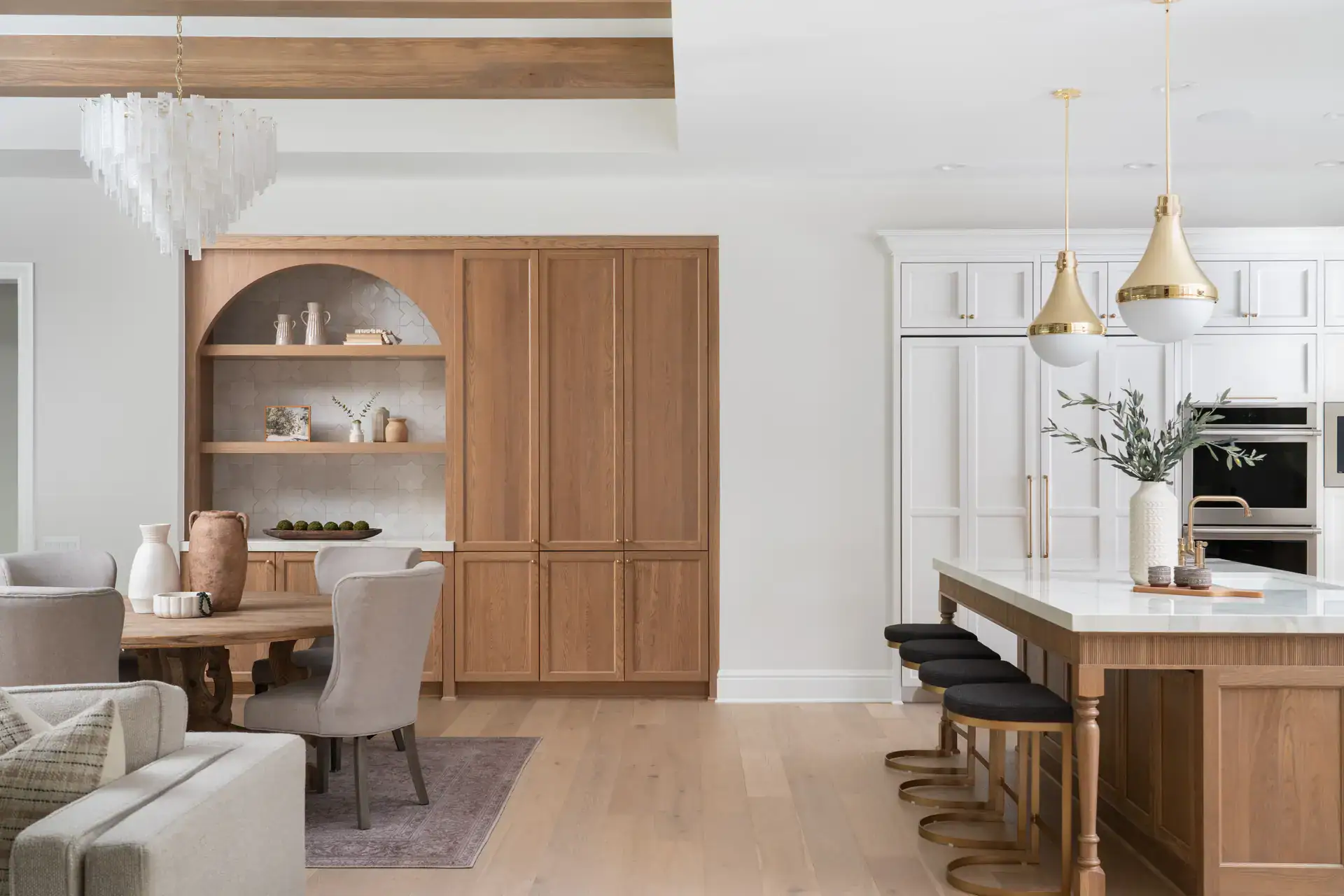
Furnished rooms is a moment that happens on staging consultations with a regularity that never stops being satisfying. A seller, or sometimes a designer, or sometimes a real estate agent who has been in the industry for years, stands in an empty room and makes a confident assessment about how much furniture it can hold. They look at the square footage, they look at the walls, they look at the floor space, and they arrive at a conclusion that feels entirely reasonable based on everything they can see.
And then the tape measure comes out.
What the tape measure reveals, almost every single time, is that the room is significantly larger than the person standing in it believed. The bedroom that looked like it might struggle to fit a queen bed comfortably turns out to have space for a king with nightstands on both sides, a bench at the foot of the bed, a full dresser, and a seating area in the corner. The living room that felt like it could hold a sofa and maybe one accent chair turns out to have room for a full conversation grouping with a coffee table, two chairs, a side table, and still leave generous circulation space on every side.
Home staging room did not get bigger. The perception of it changed. And that change in perception is one of the most powerful financial levers available to a seller preparing to list, because buyer perception of room size is directly and measurably connected to buyer perception of value.
This blog is about that connection, why empty rooms feel smaller than they are, what happens to perceived size when furniture enters the equation, and why understanding this counterintuitive principle is one of the most important things a seller can do before their listing goes live.
The Tape Measure Moment That Changed Everything
Let me share a specific story because abstract principles land differently when they are grounded in a real moment with real stakes.
Not long ago, a staging consultation was happening at a luxury new construction property. The builder had invested significantly in the home. The finishes were exceptional. The craftsmanship was evident in every detail. The primary bedroom was spacious by any objective measure, a genuinely generous room that represented one of the home’s strongest selling points.
The designer responsible for the home’s design decisions was present for the consultation. This was someone with deep experience in the industry, someone who understood space professionally, someone whose entire career involved making decisions about rooms and finishes and layouts. And when the conversation turned to staging the primary bedroom, she hesitated.
The budget was a consideration. She was not sure staging was necessary for a room that was already beautiful and already well-finished. And when asked how much furniture she thought the room could hold, she gave an answer that felt entirely reasonable given what she was looking at. A bed and a dresser. That would probably be about right.
The tape measure told a different story.
When the dimensions were walked out on the floor, when the length of a king bed was marked from one point to another and the remaining floor space was made visible through the simple act of measuring rather than estimating, the designer’s face changed. She looked at the space between the end of where the bed would sit and the far wall. She looked at the space on either side. She looked at the corner that had felt cramped in her imagination and was now clearly large enough for a full seating area.
And she said something that captures the entire principle in a single sentence. This room is so much bigger than I even realized.
A professional designer, standing in the room, could not accurately perceive its size without the reference points that furniture provides. If that is true for a trained expert, it is dramatically more true for a buyer who walks through dozens of properties, evaluates rooms quickly, forms impressions in seconds, and moves on.
That designer looked at the staging consultant and said: we need to stage this bedroom. Everyone needs to see just how spacious this is.

Why Empty Rooms Feel Smaller: The Perceptual Psychology
To understand why this happens, it helps to understand something about how the human visual system processes space.
The brain does not perceive room size in a vacuum. It perceives room size relative to reference points. When you look at an empty room, your visual system has very little to work with in terms of scale calibration. The walls are there. The floor is there. The ceiling is there. But without objects of known size to compare against, the brain struggles to accurately estimate the dimensions of the space.
This is not a failure of intelligence or attention. It is a fundamental feature of how human spatial perception works. We are extraordinarily good at judging the size of things relative to other things. We are considerably less reliable at judging the absolute size of things in isolation.
Furniture provides the reference points that empty rooms lack. When a king bed is placed in a bedroom, it gives the brain an object of known dimensions to calibrate against. The distance between the edge of the bed and the wall suddenly becomes perceivable as a specific amount of space rather than an abstract expanse. The corner that felt undefined and a little uncomfortable now has a relationship to the furniture that makes it legible. The room does not get bigger in any physical sense. But the brain’s ability to accurately perceive its size improves dramatically.
And here is the counterintuitive part that surprises almost everyone who hears it for the first time. The perception of size that results from having furniture in a room is almost always larger than the perception of size the empty room produced. Not smaller. Larger.
This happens because furniture breaks up the undifferentiated expanse of an empty room into comprehensible segments. Each segment is perceivable as a specific amount of space with a specific relationship to the furniture anchoring it. The sum of those segments, experienced sequentially as the eye moves through the room, produces a sense of spaciousness that the empty room’s undifferentiated expanse could not generate.
Buyers who walk through empty rooms routinely underestimate their size. Buyers who walk through furnished rooms routinely perceive them as larger than buyers who saw the same room empty. This is not opinion. It is a documented perceptual phenomenon with real implications for how buyers assess value, and therefore for what they offer.
What Perceived Size Has to Do With Perceived Value
This is where the perceptual psychology of empty rooms connects directly to the financial outcomes sellers care about, because perceived room size and perceived property value are not independent variables. They are deeply and consistently linked.
When a buyer perceives a room as smaller than it actually is, several things happen simultaneously in their assessment of the property.
First, they begin to question whether the home meets their practical needs. A bedroom that looks like it might not comfortably fit their furniture is a bedroom they start to worry about. That worry becomes a reason to hesitate, a reason to keep looking, a reason to frame the home as a compromise rather than a discovery. And buyers who feel like they are compromising do not offer at asking price.
Second, they begin to make downward adjustments to their sense of the home’s value. Space is one of the primary drivers of real estate value. Buyers know this intuitively. When a home feels smaller than the listing sheet suggests it should, the gap between perceived size and advertised size creates cognitive dissonance that buyers resolve by discounting the price they are willing to pay. They are not doing this consciously. They are not sitting down and calculating a dollar amount per square foot of perceived versus actual size. But the adjustment happens, and it shows up in the offer.
Third, they become less emotionally engaged with the home overall. Emotional engagement in a real estate context is significantly tied to the sense that a home has room for a buyer’s life, room for their furniture, their family, their daily routines, their aspirations. An empty room that feels smaller than it is does not invite the imagination to populate it. It creates uncertainty about whether the imagination can fit. And uncertainty is the enemy of the emotional engagement that produces offers.
Staging resolves all three of these problems simultaneously. It provides the reference points that allow accurate size perception. It demonstrates concretely that the home has room for a full, beautiful, functional life. And it creates the emotional context in which buyers stop worrying about whether things will fit and start imagining how wonderful it will be when they do.

The New Construction Paradox
One of the places where the scale and perception principle is most frequently misunderstood is in new construction, and it is worth addressing directly because the misconception is so common and so costly.
The logic that leads builders and developers to skip staging on new construction goes something like this. The home is perfect. Everything is new. There are no scuffs, no dated finishes, no signs of wear that need to be minimized or worked around. The quality of the craftsmanship speaks for itself. Why introduce the cost and complexity of staging into a home that is already presenting at its best?
The answer is that craftsmanship and scale are two entirely different things, and one does not solve for the other.
A beautifully finished empty room communicates quality. It does not communicate size. And in luxury new construction especially, where rooms are often genuinely large, the failure to communicate size through staging means that buyers are routinely underestimating the very feature that justifies the price point.
A luxury primary bedroom that is fifteen feet by eighteen feet is a genuinely impressive room. Empty, it often does not read as impressive. The scale is difficult to perceive, the proportions are difficult to appreciate, and the potential of the space, the seating area in the corner, the generous nightstand space on both sides of the bed, the room for a bench at the foot, is completely invisible because there is nothing in the room to make it visible.
Staged, that same room becomes one of the strongest selling points in the home. Buyers walk in and feel the generosity of the space in a way that the empty version never allowed. They understand, immediately and viscerally, that this is a primary suite worth aspiring to. And that understanding, produced by staging, is what justifies the price to a buyer who might otherwise have stood in the empty room and thought the space seemed adequate but not exceptional.
The question that the tape measure answers, and that staging makes visible, is not whether the room is big enough. The room is almost always bigger than buyers perceive it to be. The question is whether buyers are given the tools to perceive it accurately. In an empty new construction home, the answer is almost always no. And the financial consequence of that perceptual gap shows up in offers that do not reflect the actual quality and scale of the home being sold.
Scale Mistakes That Cost Sellers Money
There is a version of the scale problem that works in reverse, and it is equally important for sellers to understand.
Just as empty rooms can make a space feel smaller than it is, the wrong furniture can have the same effect. Undersized furniture in a large room does not make the room feel larger. It makes the room feel awkward, the furniture feel lost, and the overall presentation feel unresolved. A queen bed in a room that calls for a king does not communicate a generous primary suite. It communicates a room that is not quite sure what it wants to be.
Oversized furniture creates a different problem. A sofa that is too large for a living room makes the room feel cramped and the furniture feel dominating. Buyers who walk into a room where the furniture scale is wrong do not think “the furniture is too big.” They think “this room is too small.” The furniture scale shapes the perception of the room, not the other way around.
This is one of the most important reasons why staging requires professional expertise rather than simply filling a space with available furniture. The relationship between furniture scale and room perception is nuanced, specific to each room’s dimensions and proportions, and consequential enough to significantly affect how buyers experience and value a home.
A professional stager approaches every room with an understanding of these relationships. They are selecting furniture not just for how it looks in isolation but for what it communicates about the room it occupies. A king bed with substantial nightstands and a full upholstered headboard in a primary bedroom does not just look beautiful. It proves to the buyer’s brain that this room is generous, spacious, and worth the price point. A properly scaled sofa and conversation grouping in a living room does not just feel comfortable. It demonstrates that the room has real capacity and real livability.
Every furniture selection in a professionally staged home is a deliberate communication about the scale and value of the space it inhabits. And those communications add up, room by room, to a buyer experience that consistently produces stronger price anchoring and stronger offers than the same home empty could generate.

What Buyers Remember and What They Offer
Here is a practical reality of how home buying decisions get made that brings the scale principle home in the most direct way possible.
After a showing, buyers sit down with their agent and talk about what they experienced. They describe the rooms they remember, the feelings those rooms produced, and the sense they formed of the home’s overall quality and value. And here is what that conversation almost never sounds like after a showing of an empty home.
It almost never sounds like “I could really see the potential of the space.” Despite the common intuition that empty rooms are canvases that buyers will fill with their imaginations, that is rarely what actually happens. What buyers remember about empty rooms is uncertainty. Did my furniture fit? Was the room actually as large as the listing said? Was the layout going to work for us? Those questions do not produce enthusiasm. They produce hesitation.
After a showing of a well-staged home, the conversation sounds entirely different. Buyers describe specific rooms with specific feelings. The primary bedroom felt like a retreat. The living room felt generous and bright. The dining room felt like a space where they could actually host the dinner parties they have been imagining. These descriptions are emotional and specific, and they are produced by the staged environment that gave buyers’ imaginations concrete material to work with.
Emotional specificity in post-showing descriptions is strongly correlated with offer-making behavior. Buyers who can describe what they loved about a home in specific emotional terms are buyers who are moving toward a decision. Buyers who describe uncertainty and unanswered questions are buyers who are moving toward the next showing.
Staging produces the emotional specificity. And the scale perception that staging creates, the sense that rooms are generous and spacious and full of possibility, is one of the primary drivers of that emotional response.
The Luxury Market Multiplier
Everything discussed in this blog applies across price points and property types. But the financial implications of scale perception are particularly pronounced in the luxury market, and sellers of higher-priced properties should understand why.
In luxury real estate, space is one of the primary value drivers. Buyers at the top of the market are not just purchasing square footage. They are purchasing the feeling of abundance, the sense that their home has more than enough room for everything their life requires and everything their aspirations demand. That feeling is not produced by a number on a listing sheet. It is produced by the experience of moving through the home and feeling its generosity in a visceral, immediate way.
An empty luxury home, regardless of its actual square footage, rarely produces that feeling. The scale calibration problem is, if anything, more acute in large rooms than in small ones because the greater the actual size, the greater the potential gap between perceived and actual dimensions when there is nothing in the room to serve as a reference point.
A professionally staged luxury home creates the feeling of abundance that luxury buyers are seeking. Properly scaled, high-quality furniture in generous rooms communicates that this is a home worth its price. It proves, through the concrete reality of the staged space, that the home has room for the lifestyle its price point promises. And that proof, experienced emotionally and viscerally rather than read on a specification sheet, is what produces the premium pricing that luxury staging consistently generates.
According to available data on luxury staging outcomes, homes in the $750,000 to $1.49 million range staged professionally commonly achieve approximately 9 to 10% over list price. On a million-dollar property, that is $90,000 to $100,000 in additional sale proceeds. The staging investment that produced that return, typically $5,000 to $10,000 for a property at that price point, represents a return on investment that virtually no other pre-sale preparation strategy can match.
The scale perception principle is a significant part of why. When luxury buyers walk into a staged home and feel the genuine generosity of well-presented spaces, they are experiencing the home at its full value. That experience anchors their price expectations in a way that an empty home, however beautifully finished, simply cannot replicate.

What the Tape Measure Is Really Telling You
The tape measure story is ultimately about more than room dimensions. It is about the gap between what a space actually offers and what buyers are able to perceive without help.
Every empty home carries that gap. Every unstaged room is presenting itself at a fraction of its actual capacity, asking buyers to supply the imagination and reference points and scale calibration that staging could have provided. Some buyers can bridge that gap on their own. Most cannot, at least not fully, at least not in the compressed time frame of a showing where first impressions are forming and decisions are being made.
Staging closes the gap. It gives buyers the reference points they need to perceive space accurately. It proves that rooms are larger than they look empty, more functional than they feel unfurnished, and more worth their asking price than a cold expanse of empty floor could ever communicate.
The designer who stood in that luxury primary bedroom and said this room is so much bigger than I even realized was not making an observation about the tape measure. She was making an observation about perception, about how easily even trained professionals underestimate empty space, and about why staging is not optional for a home that needs buyers to understand its full value.
If your home is vacant, or if you are preparing to list and wondering whether staging is worth the investment for rooms that are already generous and well-finished, the tape measure has something to say about that. Connect with the Linden Creek team for a staging consultation and let us show you what your rooms actually look like when buyers have the reference points they need to see them clearly.
Because the room is almost certainly bigger than you think. Staging is what makes sure buyers know it.
Leave a Reply